If you ask a theoretical physicist how an electron emits a photon when it changes orbital, you will likely encounter an explanation that challenges every intuitive notion of geometry. You will be told that energy spreads through space as a doughnut-shaped wave (dipole radiation) and that, the moment it encounters an obstacle such as your retina or an atom on a screen, this immaterial cloud instantly vanishes, concentrating all its energy into a single random point.

This is called wave function collapse.

But let us be honest: from a purely geometric and structural perspective, this explanation is not very plausible. It resembles a mathematical wildcard, a conceptual device introduced to patch over a deeper inconsistency. The numerical predictions of Quantum Mechanics are extraordinarily accurate. They predict the behavior of microchips and lasers to astonishing decimal precision, yet the physical picture that emerges often borders on the absurd.

We are not alone in experiencing this frustration. Albert Einstein rejected this interpretation throughout his life (“God does not play dice”), dismissing action at a distance as something ghostly and unacceptable. Erwin Schrödinger devised his famous cat-in-the-box paradox precisely to illustrate how radically quantum orthodoxy challenged common-sense realism.

Today, fundamental physics finds itself in a deep intellectual dead end. In our attempt to make the equations work, we have accepted increasingly strange compromises, from nonlocality to the multiplication of infinitely many parallel worlds. But how can we regard as satisfactory a model that abandons locality in order to explain phenomena we do not fully understand, involving objects we cannot properly define, within a spacetime whose true nature remains unknown?

Rethinking the Atom: From “Empty Apartments” to Internal Dynamics

The problem does not lie in the universe itself but in the assumptions underlying our models, particularly in the way we conceive particles and fields.

Consider atomic orbitals. They are often imagined as physical tracks occupied by electrons, but they are merely mathematical solutions. A hydrogen atom contains only one electron, yet it possesses infinitely many orbitals. It is like an empty apartment building: the upper floors and apartments always exist as geometric possibilities and energetic rooms, even though the single tenant (the electron) normally resides on the ground floor, the fundamental 1s state.

When a photon with exactly the right energy strikes this tenant, it does not randomly excite an electron. It interacts with the only electron whose energy separation matches the incoming photon. At that point, the electron does not shrink into a smaller or tighter ball. Within the bound world of the atom, more energy means occupying a larger volume. The electron expands into the outer apartments.

The real mystery appears when the electron decides to return to a lower-energy orbital.

The Trap of Nonlocality and the True Meaning of Entanglement

Classical physics tells us that an accelerating charge emits electromagnetic waves. During a quantum transition, the wave corresponding to the initial orbital and the wave corresponding to the final orbital overlap for an infinitesimal fraction of a second, creating an oscillating dipole. The electron cloud vibrates like an antenna and geometrically radiates the excess energy along the plane perpendicular to the axis of oscillation, giving rise to the photon.

If this photon must travel outward, why is it not immediately reabsorbed by the atom’s other electrons?

The answer lies in quantum transparency. The other electrons are effectively deaf to that specific frequency because they possess no available energy levels at precisely that separation. The photon passes through them as though they were not there.

The deeper conceptual difficulty arises when physics, unable to provide a clear geometrical explanation for both the wave-like propagation of the photon and its eventual detection, chooses to abandon locality instead. Locality is the fundamental principle that an event occurring here cannot instantaneously influence an event occurring there. Out of this gap in understanding emerges the popular myth of “quantum telepathy” associated with entanglement.

Yet entanglement is not some ghostly physical connection. It is, more simply, a correlation between quantum states: the probabilistic outcome of measurements performed on systems created together and constrained by strict conservation laws.

If we separate a pair of gloves and send one to Paris and the other to New York, discovering that the Paris glove is left-handed instantly tells us that the New York glove must be right-handed. No superluminal signal has been exchanged. No magic has occurred. What we observe is merely the consistency of the original geometric structure revealing itself at the moment of measurement.

Breaking the Dogma: Yes to Indeterminacy, Yes to Locality

To move beyond this impasse, a third path may be required: redefining the quantum object by reuniting three dimensions that modern physics has largely separated:

  • the logic of states,
  • the geometry of the metric,
  • the internal dynamics of physical structures.

We must challenge a subtle but powerful dogma: the assumption that being “elementary” (indivisible) necessarily means being devoid of internal dynamics.

Contemporary physics models the electron as a dimensionless geometric point, an abstraction that generates the notorious mathematical infinities of quantum field theory. But if we allow a particle to be both elementary and indivisible while simultaneously possessing an extended three-dimensional geometric structure such as a vortex, a knot, or a topological singularity of spacetime itself, many conceptual difficulties begin to dissolve.

  1. A vortex is not made of parts. It is the underlying medium in motion. It possesses its own internal dynamics, including frequency, spin, and torsion, without requiring smaller constituent components.
  2. Indeterminacy becomes a genuine geometric property. One cannot simultaneously measure the infinitesimal position and the frequency of an extended vortex because the vortex necessarily occupies a finite volume. Yes to indeterminacy, therefore, but yes also to locality. Geometrical rearrangements remain local and continuous.

The current crisis in fundamental physics is not the end of scientific inquiry but the classic symptom of a paradigm approaching its limits. We have become exceptionally skilled manipulators of statistical equations, yet we have largely abandoned the audacity of ontology: the effort to ask what reality actually is in geometric terms.

The way out of the present deadlock will not come from an even more complicated formula, but from a new, coherent, and ultimately more plausible way of understanding the invisible structures that shape our universe.
Knowledge Systems represent the structured forms of Meta-Reality—organized, dynamic, and conservative ensembles of meta-entities, semantic networks, and networks of networks. In essence, they are representations of Reality that emerge and evolve within living beings.

These systems enable purposive agents—living organisms endowed with finality—to explore Reality in an evolutionary manner, constructing and refining internal models of the world that guide their behavior. Through interactions of varying complexity with the environment, these agents pursue goals instrumental to their causal permanence, both individual and collective: self, offspring, species, and, at times, the surrounding ecosystem.

Knowledge Systems thus express the representational schemes that mediate evolutionary interaction with the world. These schemes range from simple sensory discriminations—such as the detection of energy gradients—to more articulated patterns of recognition (self/other, friend/foe, food/poison), and extend to complex frameworks of social, economic, and cultural interaction.

In this light, Knowledge Systems are not merely passive repositories of information, but active architectures of meaning that shape and are shaped by the evolutionary trajectories of the agents that inhabit them.


In recent months, as anticipated, I have been dedicating myself to proofreading and revising the content — with particular attention to streamlining and eliminating duplication.

I have completed the revision of the Abstract and chapters 1. Introduction, 3. Reality? Universe?, and 12. Conclusions: a look into the future. For the past couple of months, I have been working on chapter 11. The Forms and the Universe, where — unfortunately — I found some sections only sketched out, which required considerable time to fully develop.

Very soon, I will resume the revision of the second part of this chapter, and then I will aim to proceed more quickly with chapters 4, 5, 6, and 7, which are shorter and less complex and articulated.

I will also try to resume the development of the illustrations, which I had to interrupt in order to focus on the demanding writing of the missing parts of chapter 11.

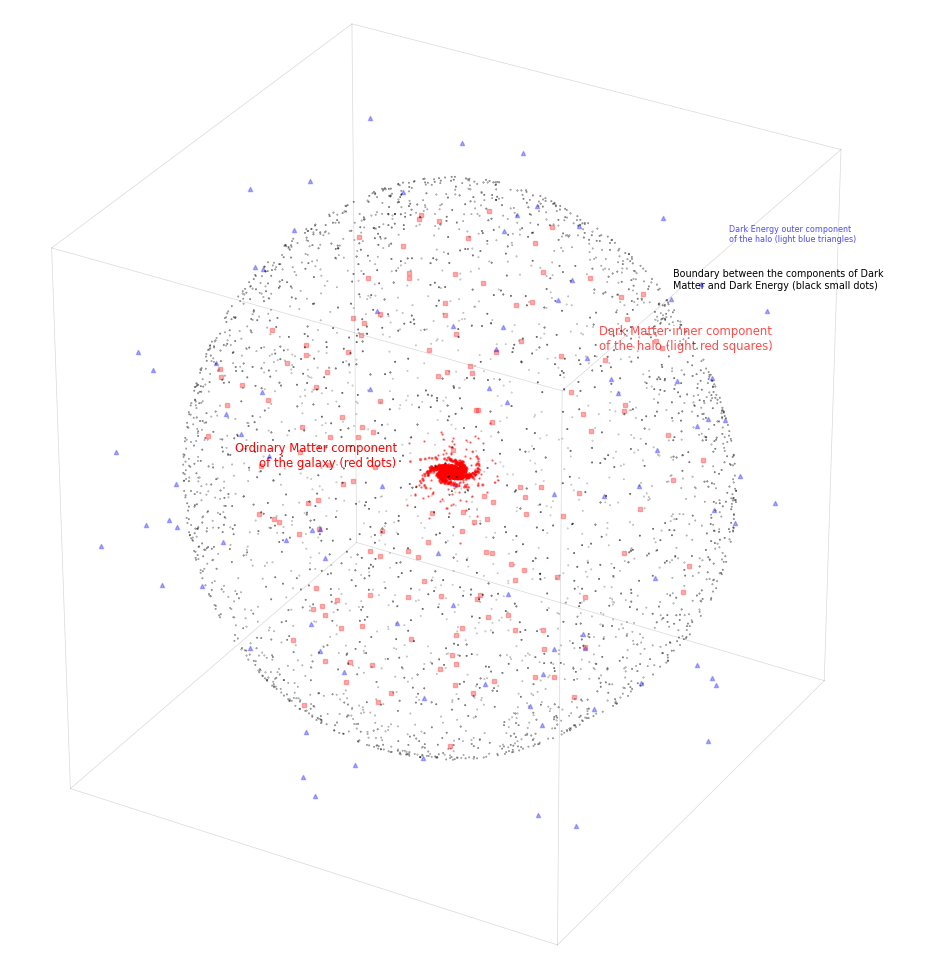
A small sample of the illustrations I am working on — created using the Python programming language and its fantastic graphics libraries and mathematical features…

Paper Front


I highly recommend this video available on YouTube.

As mentioned at the bottom of the video:

The Hubble Space Telescope’s Ultra Deep Field imagery peers 12 billion light-years away from Earth to the early Universe. The team at the Space Telescope Science Institute has created an amazing look at the past in this 3D visualization.

Hubble’s Ultra Deep Field in 3D is an amazing journey through space and time

Credits: https://youtu.be/2sUrauA0iq4?si=X2TMQ8_yKK9efu3S


After many years of work, today I finally finished writing the first draft of the paper Updates on the paper “The Fundamental Nature of Reality – An Introduction to Evolutionary Physics”. Launched the process of compiling the pdf file, obtained 450 pages. A lot of pages. Here is the list of chapters. Twelve of course!

Paper Front

1- Introduction
2 – A first look
3 – Reality? Universe?
4 – The Fundamental Nature of Reality
5 – What exists? What happens? How happens?
6 – The Process of Formation of Physical Reality
7 – The Primary Source of Reality: the Fundamental Force and the Elementary Field
8 – Action: the Creation of Existence
9 – Information: the Evolution of Essence / Form
10 – The Structures of Information
11 – The Forms and the Universe
12 – Conclusions: a look into the future

Now the work is changing and will focus on two complementary directions:
-proofreading and revision of the contents (especially with streamlining and elimination of duplication)
-design and creation of the illustrations (many of which will have to be created through programming in Python)


The Short Version…

The evKnowledge – Evolutionary Knowledge Project is an interdisciplinary research initiative dedicated to the study of Knowledge Systems and to the development of the Evolutionary Knowledge Framework, a new theoretical framework aimed at understanding the nature, structure, and dynamics of Reality.

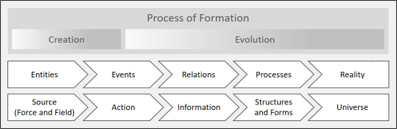
The Project adopts an evolutionary and constructivist perspective, according to which Reality can be interpreted as an ongoing Process of Formation, articulated through the two complementary processes of Creation, understood as the dynamics of Action, and Evolution, understood as the dynamics of Information.

By integrating contributions from the natural sciences, philosophy, cognitive sciences, and the comparative study of cultural and symbolic systems, evKnowledge seeks to develop a unified conceptual framework capable of describing, interpreting, and formalizing the processes through which physical Reality, life, mind, knowledge, and complexity emerge.

The Project’s activities are organized into several interconnected Research Areas and encompass both the analysis of traditional knowledge models developed throughout human history and the construction of new theoretical, conceptual, and representational tools for the study of Reality and the evolving Universe.

In addition to theoretical research, the Project promotes the dissemination and sharing of its findings through publications, educational activities (through the “evKademy” initiative), digital tools, and cultural programs.


A Closer Look…

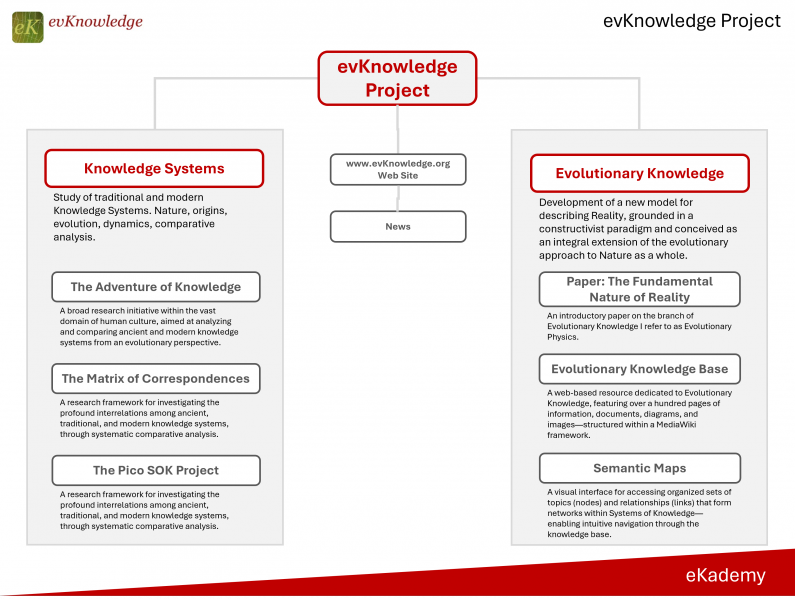
The evKnowledge Project is conceptually articulated into two tightly interrelated domains: Knowledge Systems and Evolutionary Knowledge.

The former centers on the study of traditional and contemporary knowledge systems, examining their nature, origins, evolution, dynamics, and comparative frameworks.

The latter is oriented toward developing a new model of Reality, rooted in a constructivist paradigm and envisioned as a comprehensive extension of the evolutionary approach to Nature.

The Project is articulated through the following interconnected Research Areas:

  • Evolutionary Knowledge
  • Adventure of Knowledge
  • Discipline of the Force
  • artEvolution
  • evTek – Evolutive Technologies

To support this initiative and foster the dissemination of Evolutionary Knowledge, I am also building key resources:

  • eK Website, Wiki, and Semantic Maps
  • Project presentations
  • Foundational documents and publications


evKnowledge Project


Knowledge Systems

This is a research project focused on the study of knowledge systems themselves. It aims to describe their nature, origin, evolution, and dynamics across all dimensions and manifestations—at every level of complexity of living beings, who continuously construct them as systems of world representation and use them to guide their behavior.

The “Adventure of Knowledge” Project

This project is a broad research initiative within the vast domain of human culture, focused on the analysis and comparison of ancient and modern knowledge systems from an evolutionary perspective. Open the paper “La Matrice delle Corrispondenze” (Italian version). Open the paper “Scienza, Cabala e Alchimia” (Italian version).

The “Pico SOK” Project

This project promotes research into the study, analysis, and management of the evolutionary dynamics of Knowledge Systems through a highly innovative approach. Originating within the evTek – Evolutionary Technologies research area, as part of the broader Evolutionary Knowledge Project (evKnowledge), the initiative is dedicated to developing new methodologies and tools for the creation, organization, and exchange of knowledge—grounded in the fundamental principles of evolutionary research. Open the presentation of this project.


The Evolutionary Knowledge Project

The Evolutionary Knowledge Project is a research initiative aimed at constructing a new System of Knowledge and developing a comprehensive model for describing Reality. It is grounded in a constructivist paradigm and conceived as an integral extension of the evolutionary approach—applied to Nature in its entirety, to Reality as a whole, and to the Universe as a dynamic process in evolution. It is also a cultural initiative that promotes both the research and dissemination of Evolutionary Knowledge.

This endeavor seeks to build a unified and global representation of Reality, spanning from the most elementary levels—deep within the realm of the infinitesimally small—to the most complex and expansive domains: life, the cosmos, and the evolving Universe. Its goal is to foster deeper integration across diverse fields of inquiry, to promote the construction of a unified conceptual framework and a set of integrated cognitive tools, and to advance our understanding of Reality in a meaningful way.

The object of this research is Reality itself—conceived as a continuous and unceasing Process of Formation (Creation and Evolution)—and its manifestation, the Universe, understood as a complex evolving whole. The development of new concepts and theories, alongside the recovery of humanity’s rich cultural heritage, can contribute to a less fragmented and less dogmatic form of knowledge.

The project is articulated through the following interconnected Research Areas:

  • Evolutionary Physics
  • Evolutionary Metaphysics
  • Evolutionary Meta-metaphysics

These areas serve as expressions of both theoretical inquiry and practical application—spanning artistic and technological creation. They potentially encompass all fields of natural and human knowledge, offering an integrated view of cognitive and experiential reality.

This Project aims to describe, explain, predict, and transform:

  • To describe every aspect of Reality in terms of its most fundamental entities—even those considered indescribable by current scientific paradigms.
  • To explain how Reality functions, from its foundational principles to the full complexity of the evolving Universe.
  • To predict testable phenomena and restore the scientific method to a central role.
  • To transform our approach to research—both theoretical and experimental—by opening our minds, moving beyond dogmas, and unveiling the new, the strange, the unified, and the mysterious.

Main Goals of the Project

  • To construct a new Evolutionary Knowledge System
  • To articulate a new vision of Reality and the Universe in evolution
  • To describe the fundamental structure and dynamics of Reality—across both physical and cognitive domains
  • To develop a broad, unified explanatory framework
  • To formulate new and partly unconventional hypotheses about the foundations of Reality
  • To propose an original and useful framework for the formalization of Evolutionary Knowledge

Other Goals

To investigate and potentially resolve major mysteries in physics and cosmology, such as:

  • What is Reality? Why does it exist, and how does it function?
  • Do things exist or happen—entities vs. events?
  • What do fundamental concepts in physics (force, field, causality, space, time, mass, motion, charge, spin, energy, information, radiation, matter) represent in terms of the elementary principles of Reality?
  • Is Reality continuous or quantized?
  • Why is there (infinitely) more matter than antimatter?
  • Does Dark Matter exist? What is it, and why?
  • Is the Universe truly expanding? What is Dark Energy, and does it really exist?
  • Is the Standard Model complete? Why can’t it explain the masses of matter particles?
  • Do we need quantum gravity? Is it possible or necessary to quantize mass, space-time, and gravity?

I am developing a theoretical framework—”The Process of Formation of Reality”—which includes the sub-processes of Creation (Action dynamics) and Evolution (Information dynamics), and incorporates the structural core referred to as “The Main Causal Chain of Reality”.

Presentation of the Evolutionary Knowledge Project

New version of the presentation of the Evolutionary Knowledge Project.

It reports on the research developments of recent years, providing concise answers to the fundamental questions concerning the Project: why it exists, what are its aims and objectives, what the field of study, how do we intend to carry out the research and the diffusion of its results. What are the fundamental questions in physics and cosmology to which the Project seeks to provide unconventional answers, such as hypotheses, proposals and developments underway. Furthermore, in the last slides, three qualifying elements of this approach are illustrated in greater detail: the Process of Formation of Reality, What we see in the world. What is really fundamental?, the Evolutionary Cosmological Model.


This text, originally conceived as an introductory paper on Evolutionary Physics within the Evolutionary Knowledge Project, is an essay that synthesizes the main proposals and hypotheses developed over time to construct a new vision of Physical Reality and natural phenomena.

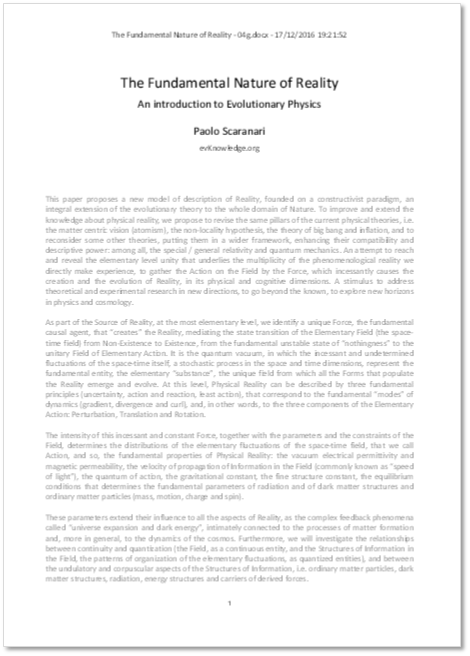
This paper introduces a new model for describing Reality, grounded in a constructivist paradigm and conceived as an integral extension of evolutionary theory to the entire domain of Nature.


Paper Front
 

To deepen and expand our understanding of physical reality, I propose a critical revision of several foundational pillars of contemporary physics—including the matter-centric view (atomism), the non-locality hypothesis, and the Big Bang and inflationary models. I also advocate for a recontextualization of key theories—such as special and general relativity and quantum mechanics—within a broader conceptual framework that enhances their coherence and explanatory power.

This work represents an effort to uncover the elementary unity underlying the multiplicity of phenomenological reality as we directly experience it. It seeks to articulate the Action on the Field by the Force—the primary expression and manifestation of the Source of Reality—which continuously drives the Creation and Evolution of Reality across both its physical and cognitive domains.

The aim is to stimulate new directions in theoretical and experimental research, to move beyond established paradigms, and to explore uncharted horizons in physics and cosmology.

Chapters
Paper Abstract
Notes on the current version
Paper Contents
1- Introduction
2 – A first look
3 – Reality? Universe?
4 – The Fundamental Nature of Reality
5 – What exists? What happens? How happens?
6 – The Process of Formation of Physical Reality
7 – The Primary Source of Reality: the Fundamental Force and the Elementary Field
8 – Action: the Creation of Existence
9 – Information: the Evolution of Essence / Form
10 – The Structures of Information
11 – The Forms and the Universe
12 – Conclusions: a look into the future

Other posts


A completely new version of the presentation of the Evolutionary Knowledge Project was released today.

It reports on the research developments of recent years, providing concise answers to the fundamental questions concerning the Project: why it exists, what are its aims and objectives, what the field of study, how do we intend to carry out the research and the diffusion of its results. What are the fundamental questions in physics and cosmology to which the Project seeks to provide unconventional answers, such as hypotheses, proposals and developments underway. Furthermore, in the last slides, three qualifying elements of this approach are illustrated in greater detail: the Process of Formation of Reality, What we see in the world. What is really fundamental?, the Evolutionary Cosmological Model.


Observations, experiments fail to find answers to the questions “Does Dark Matter exist?” and if it exists, “what is it made of?”. It is estimated that about 85% of the Matter in the Universe is invisible, the so-called Dark Matter. How can it be possible that such a large amount of Matter, which influences in a decisive way the dynamics of cosmic structures, of the entire Universe, escapes all attempts to reveal its nature. Maybe we are searching in the wrong direction, or better we are searching something wrong. Perhaps we are guided by a fundamentally wrong idea: that all Matter must be made up of Particles. Perhaps it is the ancient atomistic vision, in its increasingly accurate and spectacular versions, such as the Standard Model of Particles, that conditions our observations, our experiments.

The only evidence we should consider in this strange and difficult research is that Dark Matter appears to be a low-density stuff distributed in large clumps over vast regions of space. We see the effects of the presence of such a strange and invisible stuff, we presume it exists, but no one is able to reveal its nature and composition. Just a large number of hypotheses about more or less strange particles or changes to the laws that we think regulate gravitational phenomena, hypotheses that become less and less plausible every day, as observations and experiments place ever more stringent constraints.

What can we do to get out of this impasse? My opinion is that we should stop looking for “Particles”. Instead, we should look for something very large, with a very low density. Nothing that is now present in the Standard Model of Particles can help us. We need to try to better understand the infinitely small, what particles are in terms of what is most fundamental. We hypothesize that the same “substance” of which elementary particles are made, beyond quarks and leptons, bosons, is something that can be structured with various intensities of organization of various forms and densities. Not by chance. But following the laws that govern the dynamics of that hypothetical “substance”, dynamics that rules the conditions of equilibrium that permit the existence of structures characterized by masses, charges, spins, dynamics like those collected in the Standard Model. But not only. Also other structures, low density large extension structures precisely. And as in the case of ordinary matter particles (where it is present in a absolutely hidden, undetectable way), for those large cosmic structures made of Dark Matter, Dark Energy represents an inseparable element. These two dark stuffs being two complementary manifestations of that same hypothetical substance.

That “substance” is not “strings”, nor “spin networks”, nor “ether”, nor “modified gravity”, etc. That “substance” is Elementary Action. In particular, speaking of mass and gravity, the first mode of Elementary Action, that we call Perturbation. Its dynamics is the Dynamics of the Elementary Action.

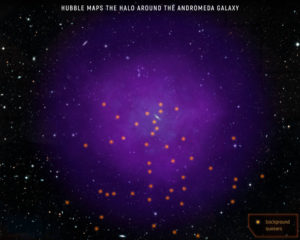
Image description: Hubble Maps Giant Halo Around Andromeda Galaxy (Credits: NASA, ESA, and E. Wheatley (STScI))
Image web source: NASA


Reality does not exist in a classical or ordinary sense. Reality happens. All that exists appear as existing because at the elementary level of Reality, in the true factory of causality (–> force) and variationality (spatiality and temporality –> space-time), the Source incessantly create and recreate the Elementary Events, that support the basic “substance”, the Elementary Action, from whose organization everything emerges and evolves at the various levels of Reality.

The whole Reality, the Universe in evolution, everything that we consider as existent, is made “by” entities, but is not made “of” entities. Everything is made up of events and relations between them. More precisely, we must say that everything is made up of processes (an evolving mix of stochastic and deterministic processes): Entities (Agents / Forces and Acted / Fields) manifesting themselves producing Events organized by Relations forming Processes.

Sources - Events - Relations - Processes

The Universe, and everything in it, is made of organized Events. In this sense, we can say that also the Universe happens, not that it exists in a conventional sense. We can only say that “it exists because it happens“. If the incessant flow of events, which sustain Reality, were stopped, Reality and its present section, the Universe, would instantly disappear (and with it also Space and Time), even if no one (no conscious beings) would notice it.

So, we must say that Reality don’t exists in a common sense. It incessantly happens, creating and evolving itself. In short, in the Evolutionary Knowledge System, Reality is considered as the creative and evolutive process (Processes|Process) by which what exists (Entities) produce what happens (Events) in the way it happens (Relations).

Nothing can be defined as entity, only the Primary Source, in its two complementary aspects, the Fundamental Force and the Elementary Field. The Source is the only “entity” in the true sense. Only the fundamental/elementary inseparable couple Force/Field can be considered as an entity. Everything else derive its existence from the fundamental/elementary Source. It is the incessant source, the origin of Existence, because it “causes” the happening, the emergence of the Elementary Events that represent the most fundamental form of Existence. Reality exists because happens, because the Source incessantly produce its happening.

The events which we are perceiving, observing, measuring, the events that compose of natural phenomena, the everyday facts that we are incessantly experiencing in our lives, always are to be considered and can be described as macro-events or Complex Events. Even the simplest events, like the emission of a photon by an excited electron in an atomic nucleus, is a complex structure of organized events. This “simple” interaction between two of the more elementary particles/waves, that we can observe in nature, in facts, involves an enormous number of Elementary Events. Each related to the others, or better, correlated in the complex forms that we call particles, both the massive ones like vortex/particles as electrons and the non-massive ones like wave/particles as photons. We also have to take in consideration all the “non-stable, short life, variable extension and shape” structures that characterize the normal dynamics of the Field, especially in the surrounding of the previously mentioned Structures engaged in a short-range interaction (which in Quantum Mechanics we call virtual particles and, more in general, quantum fluctuations of the void).